
What we learned from piloting student-led school improvement in 33 NYC Public Schools, and where we’re going next
By Jill Bass, Mikva Challenge, and Ambika Kapur, Andrew Carnegie Foundation
 We often talk about the importance of preparing young people to become engaged citizens: to vote at 18, participate in their communities, and make their voices heard on issues they care about.
But what if we started earlier? What if schools were not simply places where students learned about democracy, but places where they experienced and practiced it every day?
Democracy, after all, is not just about understanding how decisions are made. It is about having a voice in those decisions, engaging with different perspectives, and seeing that your participation can make a difference. When schools create meaningful opportunities for students to share their perspectives and influence decisions that affect them, they are putting democratic principles into practice.
The benefits extend beyond civic learning. Research by the Civic Engagement Research Group at UC Riverside suggests that when students feel heard and experience a greater sense of belonging and agency in school, they also demonstrate stronger academic engagement, motivation, and success.
A shared belief — that young people should have meaningful opportunities to shape the decisions that affect their education — brought our organizations together a couple of years ago, when Mikva Challenge launched the “Democratic Classrooms and Schools Initiative” in NYC Public Schools with support from the Andrew Carnegie Foundation.
Working with Civics for All, a K-12 initiative by the NYC Department of Education designed to reduce the civic empowerment gap and build engaged citizens, the two-year pilot consisted of developing Student Voice Committees (SVCs) in NYC Public Schools.
SVCs bring youth and adults together to identify and address challenges within a school, giving young people a seat at the decision-making table. Through a structured process of inquiry, research, dialogue, and action, students identify issues that matter to their peers, gather perspectives, develop recommendations, and collaborate with educators and principals to implement solutions. Young people learn democracy by doing democracy, complementing what they are already learning in their classes.
The pilot reached 33 public schools across all five boroughs and trained and coached 95 Student Ambassadors and 38 teachers, establishing the foundation for meaningful student voice and democratic participation in those school communities.
Working across schools with different student populations, resources, and community contexts showed us how the model works in practice and what it takes to sustain it.
One key lesson is that a meaningful student voice requires more than creating a space for students to speak. It requires adults who are prepared to listen, structures that support ongoing collaboration, and a commitment to turning student insights into action.
At one school, the SVC is tackling food insecurity, a challenge made harder because the small school lacks an adequate lunchroom and is exploring an in-school food pantry as a solution. At another school, the SVC identified a lack of physical activity opportunities as a concern among students. To better understand the issue, students administered paper surveys during lunch periods and gathered input from across the school community. The SVC then presented its recommendations directly to school leadership. As a result, the school created new morning and afternoon physical education clubs.
One student shared: “I think the best part was being able to hear from other schools issues with the lack of student voice at their school and being able to express our concerns and have the opportunity to strategize around them.”
Students also helped write a Youth-Adult Partnership Guide that gives educators, school leaders, and young people a clear understanding of youth-adult partnerships, along with concrete structures, strategies, and examples other schools can use to bring this work to life.
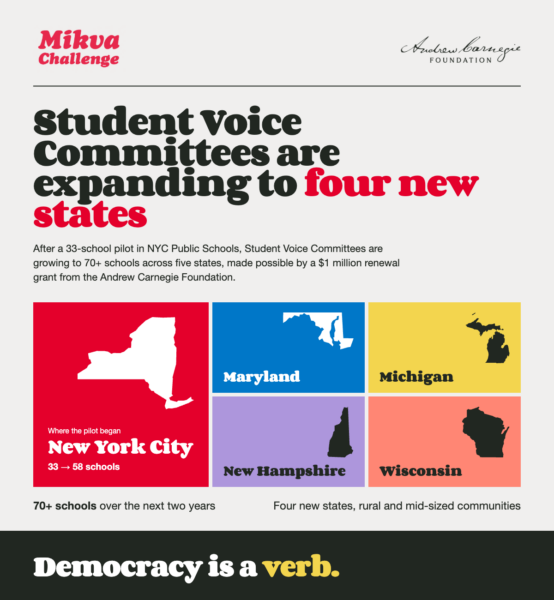
Now, with a $1 million renewal from the Andrew Carnegie Foundation, we are building on these lessons. Over the next two years, the Democratic Classrooms and Schools Initiative will increase its reach in NYC Public Schools and adapt its model for application in public schools across four news states – Maryland, Michigan, Wisconsin, and New Hampshire – including rural and mid-sized communities.
In particular, the next phase of this work will:
- Create more ways for students to share their voice. Students who don’t serve on committees will be able to participate through schoolwide surveys, town halls, and focus groups, with the aim of increasing civic participation and improving student outcomes.
- Reach more schools in New York City. The renewal will add 25 NYC Public Schools to the 33 already participating.
- Connect students across states. Virtual exchanges between partner schools will bring together about 150 students from participating states, giving young people from different backgrounds and regions new ways to learn from one another.
Democracy is not only something young people prepare for; it is something they can practice now. When schools treat students as partners, students see that their voices matter, and schools get better for everyone in them.
To learn more about Mikva’s SVCs, click here or email inquiries@mikvachallenge.org. The Youth-Adult Partnership Guide is available here.
About the Andrew Carnegie Foundation: The Andrew Carnegie Foundation was established by Andrew Carnegie in 1911 to promote the advancement and diffusion of knowledge and understanding. Today the foundation works to reduce political polarization through philanthropic support for the issues that Carnegie considered most important: education, democracy, and peace. www.carnegie.org