
Four in 10 U.S. high school students report persistent feelings of sadness or hopelessness, according to the CDC’s 2023 Youth Risk Behavior Survey. Behind that number are young people carrying more than many adults see. They’re holding down jobs, caring for younger siblings, helping support their families, and coping with the loss of a parent or loved one, all while keeping up with school.
With the support and backing of D.C. Central Office leaders, students created a platform to address the pressing issue of student mental health.

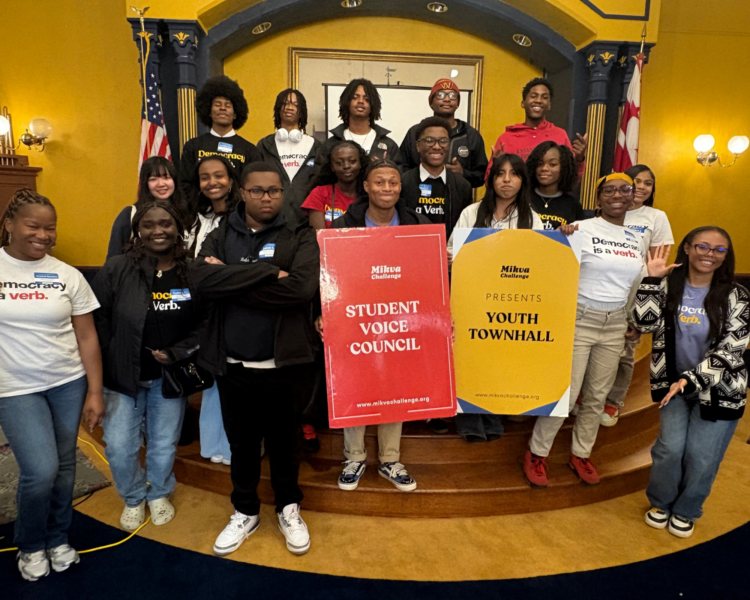 Earlier this month, more than 75 young people from 13 high schools gathered at the Charles Sumner School for the second annual Youth Mental Health Town Hall, hosted by Mikva Challenge DC’s Citywide Student Voice Council (SVC). Designed by and for young people, the event showed what happens when students lead the conversation about their own well-being.
Over four hours, participants heard from a panel of mental health providers, connected with organizations at a resource fair, and led breakout discussions with their peers. They left with a clearer understanding of what mental health is, where to find support, and how to advocate for the changes they want to see in their schools.
Who was in the room
The town hall brought students, educators, and mental health professionals together in one room. Young people from almost all DC public high schools across the city, including Ballou and H.D. Woodson, Columbia Heights Educational Campus, Duke Ellington School of the Arts, and Benjamin Banneker Academic were in the room. DCPS Deputy Chancellor Dr. Drewana Bey also stopped by to hear directly from students.
A panel of seven providers shared their expertise, including a DCPS social worker, a school psychologist, a pediatrician, John C. Fuller, founder of Therapy for Us, and Dr. Kenya Coleman, founder of Kaleidoscope Wellness.
At the mental health resource fair, organizations such as Our Minds Matter, Sasha Bruce Youthwork, and the Office of the Student Advocate shared resources students can turn to long after the event. Thank you to every panelist and partner who showed up for DC’s young people.
What students recommended
In student-led breakout discussions, young people identified concrete ways to strengthen mental health support, academic balance, and college and career readiness across DCPS.
On college and career readiness, students called for:
- Counseling that starts in 9th grade. Structured college and career exploration beginning freshman year would help students make informed decisions about their pathways well before junior or senior year.
- The same counselor from 9th through 12th grade. Keeping counselors with one cohort builds trust and helps them understand each student’s progress and evolving needs.
On academic expectations and mental wellness, students called for:
- Built-in breaks during the school day. Designated times or spaces to decompress and reset would help students return to learning ready to engage, especially at rigorous application high schools.
- Coordinated deadlines. Teachers and departments can align major assignments and tests so they don’t pile up at once and fuel burnout.
- Less homework during testing periods. Reducing homework during finals and statewide testing would give students room to prepare and manage stress.
One theme ran through every conversation: students are not asking for lower expectations. They are asking for intentional structures and supports that help them meet high expectations while protecting their well-being.
“These recommendations reflect the perspectives of participating students and open the door to continued dialogue between students, school leaders, and district partners,” said Crystal Gordon, Citywide Youth Council Manager. “We’re excited to keep exploring these issues with our council and to gather broader student perspectives through our SVC Student Voice Survey. Our hope is to turn this feedback into thoughtful, actionable recommendations that support both student achievement and well-being.”
Student research, real impact
This isn’t the first time SVC students have shared innovative solutions with DCPS to address the pressing issue of mental health.
During the 2023–2024 school year, the council’s student survey identified mental health as a significant concern for DCPS students. SVC members didn’t stop at naming the problem. They researched solutions and developed a recommendation for two mental health days each school year, giving students an excused absence for their mental and emotional well-being with parent or guardian documentation.
SVC students presented their research on mental health days directly to DCPS leaders, adding their voices to a conversation already underway among district staff and other student advocates. DCPS eventually added mental health days to its school calendar, a change SVC students were proud to have supported.
It’s a powerful example of why youth voice matters. Young people can identify challenges through data, research solutions, and bring recommendations to decision-makers. Even when change doesn’t happen immediately or exactly as proposed, their advocacy moves the conversation forward.
Mikva Challenge is grateful to the DCPS Office of School Improvement and Supports, which helps fund the Citywide Student Voice Council, and to its Chief, Paige Hoffman, who has championed SVC for all five years of its existence.
Share our Student Voice Survey with your high school students and across your DCPS network. Their feedback will help shape recommendations for meaningful change in our schools.
Interested in bringing the Town Hall to your school? Contact crystalg@mikvachallenge.org.